The veil of "regular training" with which the United Kingdom disguises its occupation of the South Atlantic has been completely lifted. Reports published by the British newspapers The Times and The Telegraph revealed the true nature and scale of the exercise carried out in recent weeks on East Malvina: a large-scale simulation of Operation Sutton —the landing of Margaret Thatcher 's invading forces in May 1982—now executed as a show of force against Argentina.
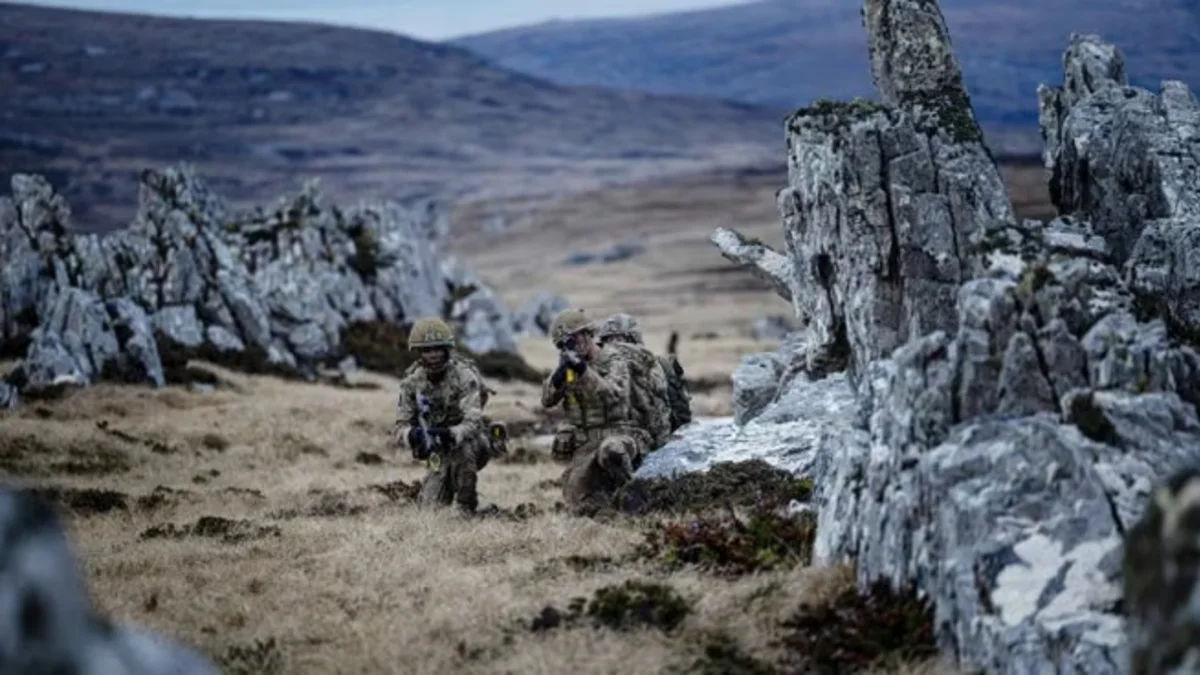
The exercise, dubbed “Cape Upholde” , lasted six days and mobilized some 150 personnel from Company B of the 2nd Battalion of the Parachute Regiment (2 PARA) along with 100 local reservists from the Malvina Islands Defence Force (FIDF) , constituting the most aggressive and explicit joint deployment recorded in recent years.
Reconstruction of the Assault: From San Carlos to Wireless Ridge
The operation mirrored the route of the 1982 war using a combined air, sea, and land force:
1. Amphibious raid on San Carlos: Assault troops from 2 PARA were projected from the patrol vessel HMS Medway and landed in semi-rigid boats on the historic coast of the strait.
2. Forced march and assault on Goose Green: After a 32-kilometer night march carrying combat equipment, troops simulated the capture and destruction of a communications center, coordinating attacks with close air support from Eurofighter Typhoon fighter jets from Mount Pleasant base.
3. Helicopter transport and combat on Wireless Ridge: Using heavy transport helicopters, the troops were moved to the hills surrounding Puerto Argentino, where they carried out close-range combat and raid exercises in rocky terrain and peat bogs.
Far from exercising diplomatic caution, the British company commander himself, Major Nunkoosing , publicly acknowledged that the maneuver sought to "follow in the footsteps of our predecessors and get an idea of the tenacity they demonstrated to achieve victory in 1982."
The real loot: Sea Lion's oil
Behind London's bellicose rhetoric and the simulation of past battles lies an urgent economic interest: hydrocarbons in the North Malvina Basin .
The military exercise coincides precisely with the British authorization to accelerate new drilling at the Sea Lion field, operated by the British company Rockhopper and the Israeli company Navitas Petroleum . Faced with arrest warrants and legal sanctions issued by Argentina against companies operating illegally on the continental shelf, the United Kingdom has responded by militarizing the territory and using Interpol to shield the plundering corporations.
The British government's warning in Parliament—asserting that they will resort to "whatever is necessary" to maintain colonial control—demonstrates that the deployment of paratroopers, ships, and fighter jets functions as the armed wing of the oil companies seeking to complete the plunder of the Argentine people's natural resources.
An open affront to the Peace Zone
The execution of Operation “Cape Upholder” dismantles any narrative about a “purely defensive” garrison. Simulating an amphibious assault and combat in the very hills where Argentine soldiers fell is not only a provocation that wounds historical memory, but also a flagrant violation of United Nations Resolution 41/11 , which establishes the South Atlantic as a Zone of Peace and Cooperation.
The empire is responding with the same old strategies from four decades ago to an international landscape that is no longer unconditionally supportive. While they try to showcase paratroopers in San Carlos and threaten the use of force, they demonstrate the fragility of their position: an isolated stronghold that needs to spend millions of dollars, mobilize fighter jets, and militarize the very settlers to protect the theft of oil and a sea that indisputably belong to the Argentine Nation.
Tags
Other news about Malvinas
United Kingdom rotates troops in the Malvinas and will begin new maneuvers
The British colony is stockpiling cargo in Punta Arenas and has set December 17th for the departure of the Danstar to the Malvinas.
Princess Anne began her visit to the Malvina Islands by inaugurating works and paying tribute to British troops.