— With the peremptory deadline granted to London having expired without a cessation of extraction activities, the Argentine Republic formally activated the jurisdiction of the International Tribunal for the Law of the Sea (ITLOS) . Through a submission filed at the organization's headquarters in Hamburg, Germany, the Argentine State requested the urgent adoption of binding provisional measures to halt the Sea Lion hydrocarbon project in the North Malvinas Basin.
The international legal action—initiated under the framework of interstate arbitration governed by Annex VII of the United Nations Convention on the Law of the Sea (UNCLOS), notified on September 28—is based on Article 290, paragraph 5 , of the multilateral treaty. This clause empowers the Permanent Court to issue peremptory orders to maintain the status quo while the definitive arbitral tribunal is being constituted, a process that typically takes several years to complete, with the tribunal comprising five members.
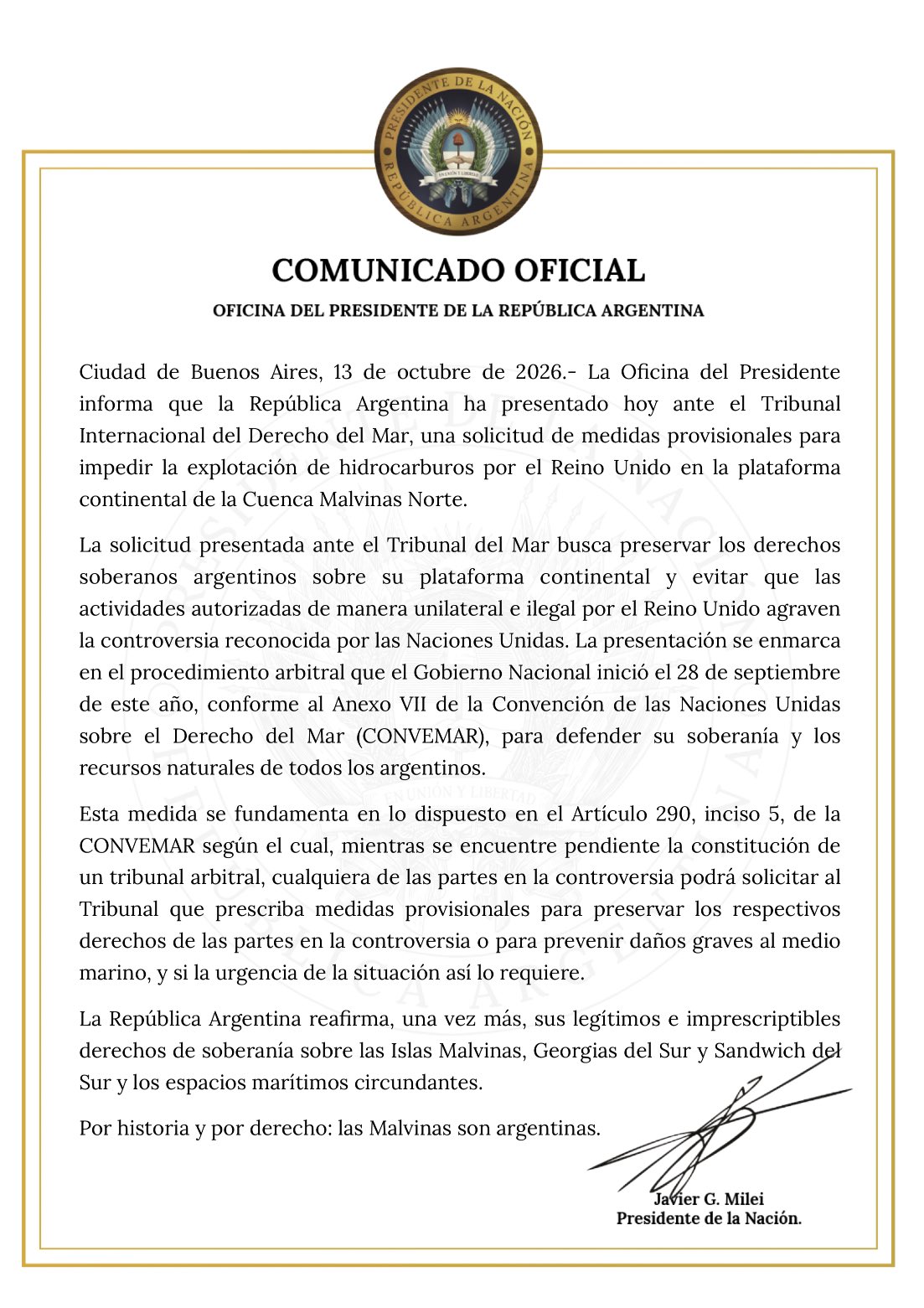
The four points of Argentina's claim before the 21 judges
The international document was technically drafted by the Legal Counsel of the Ministry of Foreign Affairs , under the leadership of Ambassador Mario Oyarzábal , with the participation of the Secretary of Legal and Technical Affairs of the Presidency, María Ibarzabal , and the Attorney General's Office of the Treasury of the Nation, headed by Sebastián Amerio .
Following the official communication issued by the President's Office, Foreign Minister Pablo Quirno detailed the four provisional measures requested from the international magistrates:
1. Immediate halt to Sea Lion: That the Court order the United Kingdom to prevent the commencement or continuation of any hydrocarbon exploration and development activity on the continental shelf of the North Malvinas Basin linked to the consortium of Navitas Petroleum and Rockhopper Exploration .
2. Prohibition on exploratory and geological data: That Great Britain refrain from using, marketing or transferring the technical, seismic and geophysical information obtained during explorations in the disputed areas to the detriment of the sovereign rights of the Argentine Republic.
3. Marine environmental protection (Articles 192 and 194 of UNCLOS): That the United Kingdom cease to obstruct compliance with Argentine environmental obligations to protect and preserve the marine environment, avoiding irreversible ecological damage and alterations to the seabed and subsoil of the continental shelf.
4. Veto on new unilateral permits: That London refrain from taking any action that aggravates the international controversy recognized by the UN, categorically prohibiting the granting of new oil licenses in the disputed maritime areas.
The strategy: to challenge unilateral acts without compromising sovereignty
The legal framework proposed by Buenos Aires deliberately circumvents the procedural trap of substantive sovereignty . Since the International Court of Justice lacks the power to resolve the historical territorial dispute—limited to the decolonization process of UN General Assembly Resolution 2065 (XX) —the Argentine argument focuses on the flagrant violation of Resolution 31/49 , which prohibits unilateral modifications in the disputed area.
Since it concerns the extraction of hydrocarbons —non-renewable natural resources whose plundering produces irreparable material damage that cannot be subsequently restored—, Argentina demonstrated the procedural urgency necessary for the TIDM to assume prima facie jurisdiction.
The path recalls the precedent of December 2012, when the Hamburg court took exactly one month to unanimously order Ghana to unconditionally release the ARA Libertad frigate , as well as the 2015 controversy between Ghana and Ivory Coast, where a TIDM chamber suspended new oil drilling in disputed maritime areas.
A consortium beset by the exodus of contractors and legal pressure
The formalization of the claim in Germany hits oil companies at their most operationally vulnerable moment:
With the formal submission of the case to the panel of 21 international judges in Hamburg, the dispute over resources in the South Atlantic enters a defining stage. In the coming weeks, it will be known whether the maritime tribunal issues a stay order that would freeze the engineering of the British colonial enclave before the planned start of drilling in Argentine territorial waters .
Tags
Other news about National
A Vox Populi poll reveals the decline in support for Milei, a Malvinas War supporter.
KEY POINTS OF ARGENTINA'S WRITTEN SUBMISSION TO THE INTERNATIONAL TRIBUNAL FOR THE LAW OF THE SEA: THE ARGUMENTS THE DELEGATION WILL PRESENT STARTING TOMORROW
Argentina begins its claim tomorrow before the International Tribunal for the Law of the Sea to stop oil extraction in the Malvina Islands.